Wednesday, 19 January 2011

Double-Break

During an inspiring break in Thailand and Laos, a fibula was broken (not mine, but being a nurse is time-consuming). This prolonged the planned break and my return to this blog will commence as soon as I have something break-unrelated and somehthing scrabbooklet-relevant to blog about (and there are exciting little things in the pipeline!).

In the meanwhile, a  slow internet connection is testing my patience on the hill-tops of Bandung. Tomorrow I shall return to some productive hours at the studio however. What has succeeded in loading is my google search for Vivienne Westwood launching an ethical fashion project, which I heard about on a friend's blog.

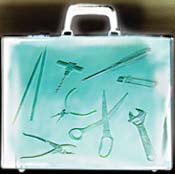
(Image: http://www.consumerreports.org/cro/resources/images/money/travel/air-security-2-08/overview/suitcase.jpg&imgrefurl)

Also, I came accros this brilliant graphic (bikes gobbling up an SUV) while browsing (ommmm, the page will load, rub them earlobes). I agree that designers are pushed to think out the box these days to convey environmental messages and the developments are exciting to  be part of.
(Image: http://www.treehugger.com/files/2011/01/bicycles-eat-suv.php)

Love from Anja Anglindo
(who will be in Indonesia just for another 3.5 weeks)

P.S. Just glimpsed on treehugger.com that organic cotton production has increased 15% in 2010 which is fabulous news!

... This post started off with the intention of writing one sentence but I realize how much I have missed the blogging; I do enjoy it. Might be superbusy with my last few weeks here as well as moving back to half way across to globe again but shall blog again before toooo long.

Sunday, 7 November 2010

books

In preparation for my MA application I am reading like crazy. Being in Indonesia doesn't make it an easy feat, as there is no decent library around where I can get the books I need. I have 3 books here that I have completely absorbed and frequently use for reference : Y. Chouinards "Let My People Go Surfing", K. Fletchers "Sustainable Fashion" and D. Goleman's "Ecological Intelligence".

I do praise my internet connection, and when that is down due to tropical storms, Wifi in cafe's are quite reliable. I intend to add a list of my fave websites soon, upon completing my papers and would now like to share where I am buying my Christmas books from (can't wait for more inspiring literature!!):

http://www.betterworldbooks.com/

They sell second hand books, (similar to Amazon marketplace, however Amazon doesn't like shipping to Indonesia) so this saves them from ending up in landfills, PLUS they donate a percentage to the world literacy fund.  scientia potentia est ... Reading brings knowledge and knowledge is power.

Rachel Carson's "Silent Spring" (1962) and "Crade2Cradle" by McDonough and Braugart will be my next purchases on the website, inspired by this article http://www.greenatworkmag.com/gwsubaccess/02mayjun/eco.html.

Merapi - "the firey one"

Merapi, the most active out the  20 active volcanoes on Java has been erupting for a couple of weeks now with the last violent explosion on Thursday.   Surono, chief of Indonesia's Volcano Mitigation and Geological Disaster Agency, told the Australian newspaper Friday."The eruptions haven't stopped, the tremors are getting stronger, and one big explosion could be the result."
Indonesia is in fact the seismically most active country in the world with 17,500 islands sitting along the Pacific Ring of Fire.
Anglindo's 2nd season collection will be donating a percentage of our profits to the Merapi Relief Fund. We are based on the same island as Merapi, in Bandung which is some 400kms away.
Photographs courtesy of the national geographic.


Wednesday, 6 October 2010

I need a new dress... sooo....


... I make one. Not from scratch this time, but from a shirt a friend of mine gave me (cheers, Bry!). In tune with my principle of trying to consume less in all areas of life to tread more lightly on this earth, I have indeed not been clothes shopping in ages and ages. Conveniently for me, my friend has decided to bide one of his cotton work shirts farewell, as he has been working out lately and now many of his clothes are to big for him; he's really tall as well, so it's perfect dress-material for little me.


There are endless of ways of customizing shirts; they are one of the most satisfactory thinks to alter, as usually dress fabrics are nice. If you want to make one yourself, this is how I did mine: 

1. detached sleeves and collar, cut a strip from the sleeves to sew together with collar to create belt
2. cut deeper neckline, front and back. make cord channel with strip from sleeve. insert cord, tack at back to fix rouching
3. detached and re-attached pocket to lower position
4. detached cuffs, reseamed them, buttoned to sleeves as detachable epaulets
5. finish armholes
6. take in side seam under the arm holes and finish side seam
7. attach belt at side seams; rouch at back waist for regular gathering

Transformation completed!

... or almost... I still have a little bit of material left from the sleeves. Now, I am against waste of any sort. So either I will use this to lengthen the hem a bit (more suitable to moslem Indoland) or make rosettes for decoration. Ideas?

I am starting to customize another (short sleeve) shirt in a sunny yellow, as the other one looks lovely. First thing is changing the neckline, although I'm liking the sleeves so far (you can't see if properly on the pic but they are gathered on the top and left to drape underneath.

Friday, 1 October 2010

Tarum means Indigo; visiting a natural dyes workshop

Near Ubud, Bali, by driving along windey roads through little kampungs (villages) towards the coast, Tarum natural dyes have their workshop. Mr. Iwan, the owner, was kind enough to show me around their lovely (really, it was, and mostly open air) workshop, explain the different dyestuffs and techniques they use and show me samples of work the have done previously.

Mr. Iwan Triadi and Mr. Made Arsana, the owners first started experimenting with natural dyes in 1998, predicting growth of the area in the next 6 years. The prediction has been fulfilled and a steady but "organic" growth of the business has taken place.

Tarum uses leaves instead of roots, bark and wood as the tree can keep on living and regrown the leaves which is a sustainable harvesting method. The dying method is inspired by traditional pre-chemical dyeing. Most of the natural blues, reds, blacks, purples, and browns on traditional Indonesian textiles come from two vegetable dyes: indigo blue, from the shrubs Indigofera tinctoria and suffruticosa, and morinda red, from Morinda trees. Mango is used for yellow and orange. The plants are locally (in their back yard or in Singaraja, north Coast Bali) grown except for the Secang which comes from West Java because it is not sufficiently available in Bali.

Leaves for dyeing grown in the back yard


Harvesting Leaves to be boiled down to the dye stuff

Indigo leaf

Colours


Tarum also have a spinning and weaving facility; a wonderfully airy, spacious, light room. I mentioned to Pak Iwan that this is a much nicer working environment compared to the stuffy garment manufacturing factories I have seen in Indonesia; Pak Iwan however laughed and said one of their companies biggest challenges is in fact to recruit workers as the young people would rather work in mobile phone shops, can you believe it!


Weaving studio


Hand loom


Being dying professionals, Tarum are constantly expanding their repertoire on dying methods and have some in stock which are looking very interesting to Studio Anglindo... 

Thursday, 19 August 2010

Fishing for plastic

My close friend Caro Sparrow in Manchester has referred me to her friend who has approached a uni fashion project in a unique and appealing manner using new technologies. 

This inspires me to go plastic fishing in the highly polluted rivers of Bandung and make beautiful trash couture out of my catch. In this country disposing of waste in rivers is common and acceptable; it gets washed away and out of sight (some of it does anyway). That plastic is non-biodegradable is not common knowledge at all. And when you think the smoke from the side walk is form incense, it's actually probably someone burning rubbish (including plastic and rubber); the other common way of disposal.


From ecouterre article:

"Sculpted from recycled and reappropriated plastics, including shower curtains, Bowler’s “Fusion” collection marries the poles-apart aesthetic of the traditional Japanese straw coat and the classic British macintosh. The Royal College of Artgraduate’s process is completely stitch-free, a combination of industrial techniques such as heat-forming and ultrasonic welding. (The latter method involves high-frequency ultrasonic acoustic vibrations to bind materials together.)

At the core of Fusion’s high-tech engineering is Bowler’s belief that recycled products can be luxurious, innovative, and desirable. “Fusion is designed to make plastic fantastic for longer,” she says. “[And] to create a garment that the owner will be reluctant to throw away.”

Bowler believes that recycled products can be luxurious, innovative, and desirable.

In keeping with Bowler’s mantra of reduce and reuse, even the rubber molds she had made are designed to be used again. The result is a series of space-age slickers in burnished metallic hues like gold, bronze, and titanium.
Fusion will be on display at the Royal College of Art’s Upper Gulbenkian Gallery, as part ofLondon Design Week, from September 23 to October 7.